
Concrete Driveway Thickness for Central Texas Properties
Thickness, base prep, and reinforcement all decide how a driveway holds up to Texas heat, occasional storms, and years of vehicle weight. Here is what actually matters.
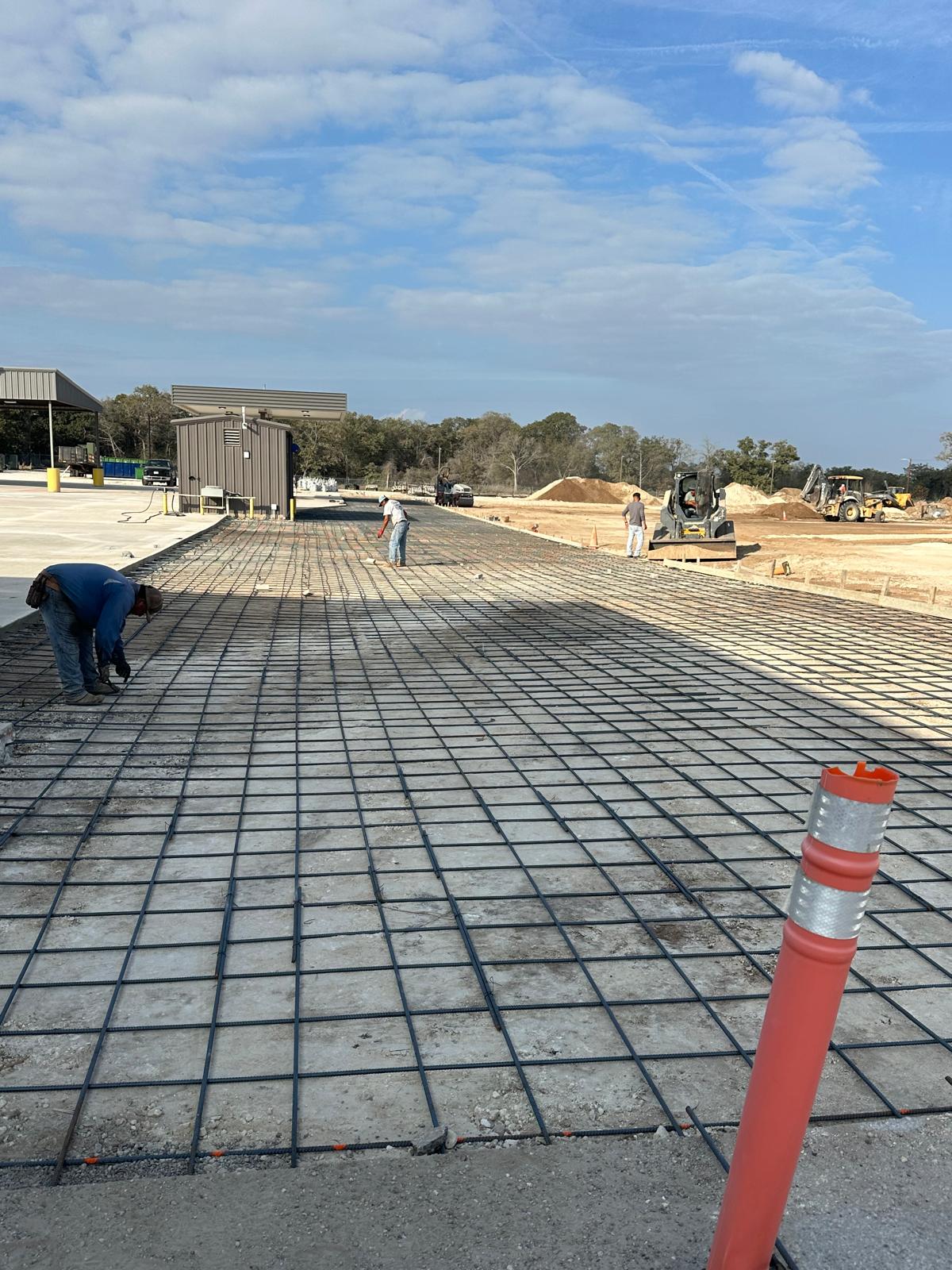
Driveway thickness is one of the first questions homeowners ask when planning a concrete project around Lockhart or anywhere in Central Texas. The honest answer is that the right thickness depends on what the driveway will carry, what the soil underneath looks like, and how the slab is reinforced — not on a single number that fits every job.
For a standard residential driveway carrying passenger cars and the occasional pickup, four inches of properly poured concrete over a compacted base is the working minimum. Most reputable contractors in Central Texas pour at four inches and add a fifth inch in driveway aprons or sections that see heavier traffic. For driveways that will see RVs, work trucks, or trailered equipment, five to six inches becomes the standard, and the base prep underneath needs to be more aggressive to match.
The base matters at least as much as the slab. Central Texas soils are clay-heavy and shift more than people expect with wet and dry cycles. A driveway poured over a thin or uneven base will crack regardless of how thick the concrete is, because the slab is being asked to bridge across soil that is moving underneath it. A solid six to eight inches of compacted crushed limestone or road base, graded and rolled before any rebar goes in, makes a four-inch slab outperform a five-inch slab over a weak base.
Reinforcement is the third leg. Steel rebar tied on a grid roughly two feet on center, suspended at mid-slab during the pour, holds the concrete together when minor cracks form. Fiber mesh adds smaller-scale crack control. Either approach, done correctly, extends driveway life dramatically. Pouring without reinforcement saves money on day one and shortens the driveway's useful life by years.
Control joints and curing finish the equation. Joints cut at the right depth and spacing within the first 24 hours give the slab predictable places to crack. Proper curing — keeping the surface damp for several days after the pour — develops the strength the mix was designed for. Both steps are inexpensive and both get skipped on rushed jobs.
CIMA Concrete plans driveway installations around the soil and use case in front of us, not a generic spec. A short site visit usually tells us whether a property needs four inches, five inches, or a more aggressive structural approach.
Planning a driveway project?
CIMA Concrete handles driveway installation, concrete repair, sidewalks, and exterior flatwork with a focus on durability and clean finish work.