
Why Concrete Is Cut on Purpose: Control Joints Explained
Concrete cracks. That is a fact of the material. The job of a contractor is to decide where the cracks go before they happen, and that is what control joints do.
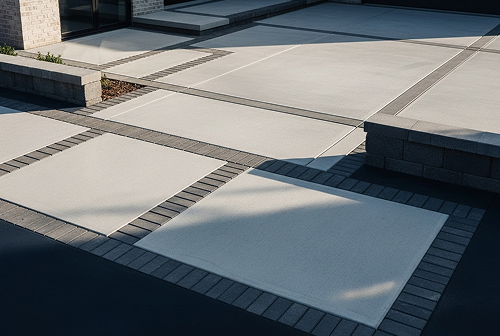
One of the most common questions homeowners ask after a concrete pour is why the contractor cut grooves into the slab. The grooves look like damage on the day of the install, but they are actually one of the most important parts of the job. Concrete expands and contracts with temperature swings, and it shrinks slightly as it cures. Without somewhere to direct that movement, the slab cracks in a random pattern. With properly placed control joints, the cracks form along the cuts, where they are nearly invisible and stay structurally sound.
Spacing is the first decision. A general rule for residential flatwork is to place control joints no farther apart than 24 to 30 times the slab thickness. For a four-inch slab, that means joints every eight to ten feet, both directions, forming a grid of roughly equal sections. Wider spacing increases the odds that random cracks will appear between the joints. Narrower spacing is harmless but more expensive in labor.
Depth matters as much as spacing. Joints need to extend about a quarter of the way through the slab — one inch deep on a four-inch slab — to actually create a weakened plane that draws the crack downward. Joints cut too shallow do not work as designed and may as well not be there. Joints cut too deep can compromise structural performance.
Timing is the third variable. Control joints are usually cut with a saw within the first 12 to 24 hours after the pour, while the concrete is firm enough to support equipment but still soft enough to cut cleanly. Waiting too long allows random cracks to form before the joints are in place. Cutting too early causes raveling at the edges.
For Central Texas properties, where summer heat drives significant expansion and clay soils add ground movement, control joints are particularly important. A driveway, patio, or sidewalk poured without them will almost always develop visible cracks within the first year or two. A slab with proper joints will still develop hairline cracks at the joints themselves — and that is exactly the goal.
Sealing the joints after the slab has cured is a small extra step that pays off. A polyurethane or silicone joint sealant keeps water and debris out, which protects both the base underneath and the edges of each section. Sealed joints last longer and look cleaner over the years.
CIMA Concrete pours every flatwork project with a planned joint layout from day one. The pattern is part of the design, not an afterthought, and it is one of the small details that separates a slab that ages well from one that cracks unpredictably.
Have a concrete project in mind?
CIMA Concrete handles driveway installation, concrete repair, sidewalks, and exterior flatwork with a focus on durability and clean finish work.