
Rebar vs Fiber Mesh: Reinforcing Residential Slabs in Central Texas
Different reinforcement methods solve different problems. Choosing between rebar, fiber mesh, or both depends on what the slab will carry and how the ground underneath behaves.
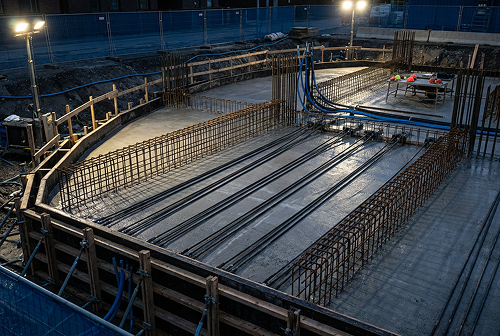
Reinforcement is one of the parts of a concrete job that homeowners rarely see and almost never ask about. That is unfortunate, because the choice between rebar, fiber mesh, or a combination of the two often determines whether a slab holds up for fifteen years or starts cracking apart in three. The right answer depends on what the slab will do, not on which method is cheaper to install.
Steel rebar handles tension. Concrete is enormously strong in compression and relatively weak in tension, which is why slabs crack when the ground underneath moves or when heavy loads create bending stress across a span. Rebar embedded at the right depth and spacing converts that tensile load into the steel, holding the slab together even when the concrete itself develops a crack. For driveways, patios over uneven ground, structural foundations, and anything that will see vehicle weight, rebar is the standard choice.
Fiber mesh works differently. Polypropylene or steel fibers are mixed into the concrete itself before the pour, distributed evenly throughout the slab. The fibers do not handle large structural loads, but they dramatically reduce shrinkage cracking and plastic-stage cracking — the small surface cracks that form during curing as water leaves the mix. For interior slabs, walkways, and lightly loaded flatwork, fiber mesh alone often does the job.
Many contractors now use both on the same project, because they solve different problems and the cost is reasonable when planned from the start. Fiber mesh in the mix handles the small-scale cracking. Rebar handles the structural loads and ground movement. The combination produces slabs that resist both kinds of failure better than either method alone.
Central Texas adds a specific reason to think carefully about reinforcement. The clay-heavy soils common around Lockhart, Luling, and Bastrop expand and contract dramatically through wet and dry cycles, putting tensile stress on slabs that would not see that movement in more stable regions. A driveway poured without rebar in this soil is gambling — the slab might hold up if the soil cooperates, but a single dry summer or wet spring can crack it across multiple sections at once.
The mistake to avoid is treating reinforcement as optional or as a place to cut cost. Skipping rebar on a driveway saves a few hundred dollars on day one and costs several thousand dollars in replacement work years later. Adding fiber mesh to a structural slab feels like extra spend until the first dry summer comes through and the slab develops surface cracks that fiber would have prevented.
CIMA Concrete spec rebar, fiber mesh, or both based on what the project actually requires. A short conversation about use case and soil conditions usually tells us exactly what a slab needs to last.
Planning structural concrete work?
CIMA Concrete handles structural concrete, driveway installation, concrete repair, and exterior flatwork with a focus on durability and clean finish work.